WHAT WORKED FOR ME IN NANOWRIMO 2025
well, here i am again, having attempted the national novel writing month challenge once again.
i don’t remember the first year i started doing this, but my first win happened in november 2016, one of the lowest years i’ve ever lived with debilitating mental illness, having distracted myself from an isolating reality by juggling organic chemistry problem sets and 1,667 original words per day. ever since then, the challenge has meant a lot to me. the best way to get better at writing is to write a lot, and nanowrimo is a challenge that encourages the kind of intense output i need to do to grow as a writer.
over the years, it’s helped me get the hang of routinely working on my writing. it’s honestly a first for me to say that i had 50,000 words of an original novel already written going into november this year, and i attribute that to the amazing community that nanowrimo fostered, allowing me to successfully write 50k words in one month every year for almost a decade.
sadly, the nonprofit organization that officially ran nano had lost its way and inevitably closed down as a result. that doesn’t mean the spirit of the challenge isn’t still alive. in fact, it’s still kicking to this day, with several writing organizations stepping up to continue encouraging folks to attempt the challenge, including a self-proclaimed “nano 2.0” being run by the nanowrimo founder and past volunteers. i, for one, had the support of a local writing group to lean on, and the organization it’s associated with also hosted a few free write-ins dedicated to the challenge. it was wonderful, and i feel so lucky to have this kind of community in my city.
(donate to litarts RI if you’re able to. they’re at a financial deficit right now due to federal funding being cut, and ever since i moved here, they’ve been a wonderful resource for me as a writer.)
i decided to be a rebel this year, seeing as i already had 50,000 words of a novel written. so i decided to make it so that my monthly goal was to reach 90,000 words by the end of november 30. why 90,000? debut novels are typically between 90,000 to 100,000 words long, so i wanted to make sure my first draft at least reached that minimum by then. great news: i succeeded! as of today, my manuscript is currently sitting at about 90,100 words, which means i wrote about 39,000 new words this past month.
what’s in my nano survival kit?
one of my favorite nanowrimo traditions used to thrive back in the day, though i’m saddened to see there isn’t an outlet for it now. back when nanowrimo had forums, someone made a thread every year encouraging others to share their nanowrimo survival kit. essentially, it was a list of items deemed important for their month-long journey. i’ve archived a forum thread from 2019, which you might also enjoy reading: [1] [2] [3]
sadly, the organization closed the forums before fully closing down entirely, and i haven’t found a decent place to share and read about other people’s kits.
so i might as well share my own here.
1) laptop: this month, i’m using a 13-inch M4 macbook air. her name is magpie and i love her. i used to own an ipad air, but found myself rarely using it these past few years. i found it to be a bit too small for my liking, and as much as i told myself i wanted to use it to draw, i never fell into the habit. so i traded it in for the macbook. frankly, this was a joy to write with. i remember the nightmare experience of typing on a 2020 macbook air with its terrible mushy keyboard, and they thankfully fixed that issue. i’ve found myself hating apple products less these days.
2) dabble writer: this is my primary writing software. think scrivener, but prettier-looking. i have a lifetime membership, and i’ve used it ever since it first became a nano sponsor back in 2018. i love using it so much. while scrivener makes me want to moan and groan using it, i happily store my worldbuilding notes, character profiles, and manuscript pages all in one place here.
3) plot embryo: having taken rachael stephen’s course, the story magic academy, i’ve been wholeheartedly embracing the plot embryo method. it’s such a seamless way for me to weave a storyline together while staying true to my protagonist’s goals and desires. i can’t imagine doing my outlines any other way, and it’s been such a great map whenever i feel lost in the actual writing.
4) noise-cancelling headphones: i use the bose quietcomfort 45 headphones. i’ve owned the same pair for about four years now, and it’s never failed me. probably one of my best QoL investments.
5) novel playlist: i always curate a playlist for every novel project i start, and i strictly listen to that playlist only when i’m working on the novel. it contains songs that either match the vibe of the novel’s setting or resonate emotionally with the novel’s characters. sometimes, i also just add fun high-energy songs to jam to in there, just to give me a mental break. (bombshell blonde by the jagged edges is currently my favorite song for that.)
6) techo + notebook: i’ve stated the importance of my techo in the past. i also keep a stalogy editor’s 365 notebook whenever i feel the urge to write fiction by hand.
7) rainbow sweater: i have a frog-themed rainbow cardigan sweater that i wear only when i’m writing. it signals to my brain that it’s writing time, and so i’m able to lock in and focus on my work without distration.
8) freewrite alpha: i bought this thinking it’d become my primary word processor. i was wrong. having funded the project on indiegogo, i figured $250 was a decent price for an alphasmart-like device with a mechanical keyboard and cloud-based document saves. but the slight inconveniences that come with using this device were too aggravating to justify using it on a regular basis. the keyboard is hard to adjust to, causing me to make multiple typos that interrupt my flow. the lack of backlight is also a pain, limiting where i can write with it.
now, i consider it my “use in case of emergency” writing device. if i can’t bring myself to write normally or i’m behind on my word count, i simply sit my butt down at my writing desk, turn on a desk lamp to illuminate the screen, and give myself a half hour on this thing. that seems to work surprisingly well, yielding me about 700-800 words per 30-minute session. i found myself using it once or twice on a biweekly basis in november, and it’s definitely saved me from word count debt. i love it for this purpose.
9) iced coffee: four pumps of vanilla syrup + caramel sauce all around the cup + a lot of whole milk + pourover coffee from a chemex = chef’s kiss.
so, what worked for me?
honestly, whether people are interested or not, i’d love to post about this in detail every year i attempt the challenge. here are some notes of what i found myself doing that most contributed to my success toward my word count goal:
1) i constantly rotated between writing methods.
i’ve accepted the part of me that just can’t stay still in one place using the same tool every day. it feels cumbersome to force myself to sit my ass down at the same workspace and type away at the same keyboard every single day.
so i switch up the location where i’m writing and the tools i’m using to write.
i have a small desk dedicated to creative hobbies and writing in the corner of my living room, but i also write at my bigger work desk. for low-energy days, i like to write in my bed (gasp) or on the couch. if i can bring myself to leave the house, i’d write at my public library or at my writing coworking space.
i rotate between writing on my laptop, my home PC, my freewrite alpha, and in my notebook. all of them have vastly different sensory experiences, which is great for someone like me who seeks out comfortable but varied sensory stimuli on the regular.
utilizing all of these options may sound odd, but hey. what works, works.
2) i wrote solely in the evenings.
you couldn’t pay me to exclusively write in the morning. there are plenty of writers who begin their work as soon as they wake up before the sun rises. i have learned and accepted long ago that i am not that kind of writer. i am a night owl through and through, so you won’t find me writing until after dinner most days.
3) i kept a spreadsheet to track my progress.
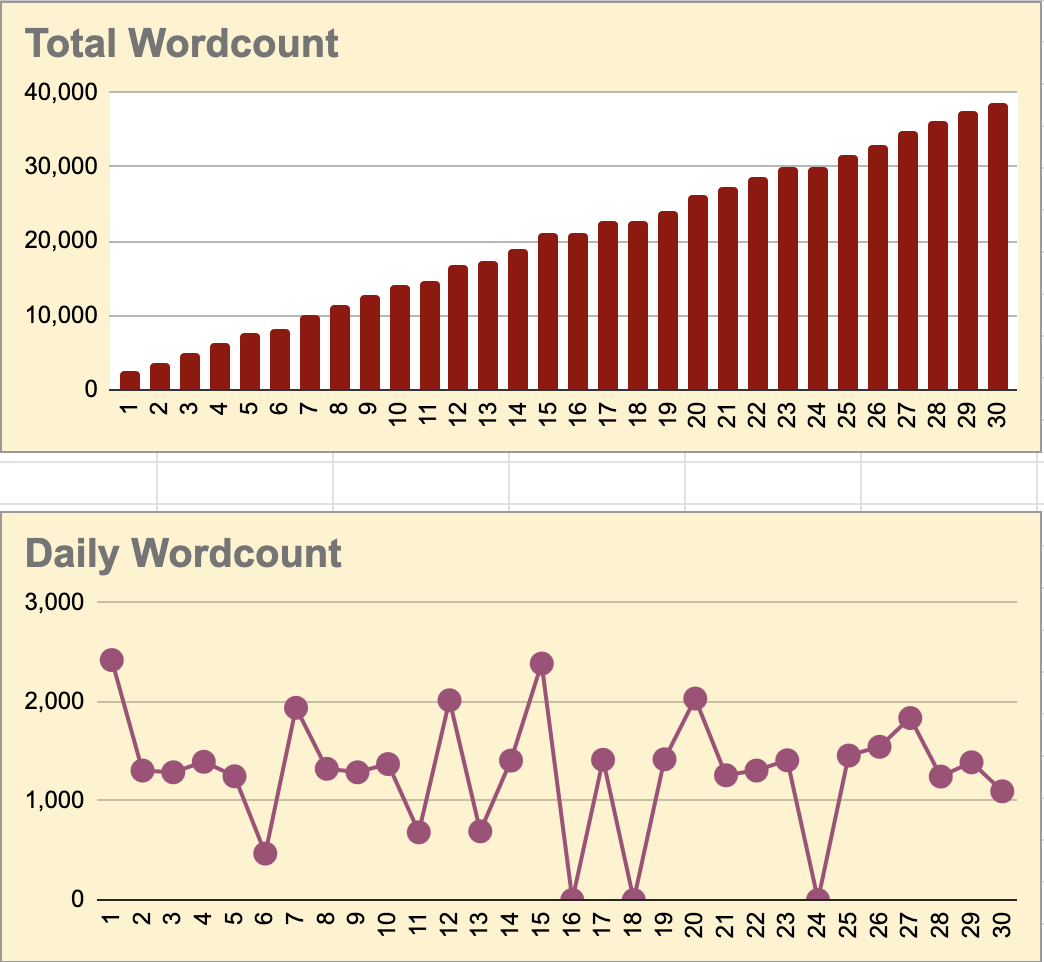
haha number go up. it feels rewarding to watch my progress gradually grow in a neat little chart. i always looked forward to updating the spreadsheet at the end of the day so i can see the charts change. you can get a blank template of this spreadsheet here.
4) i shared my word count progress regularly.
if you’ve seen me constantly updating the main page of my fiction section, that’s because i was updating the total word count of my novel almost daily. posting about my progress gave me a sense of accountability. having initially posted my goal in my nanowrimo page, i had a public place to share how my writing was going.
i didn’t care how many people were following my journey, but i still felt determined to keep going because i didn’t want to share on my site that i fell short in the end. potential bragging rights can be a good motivator. the occasional acknowledgement through the likes on my page updates was also a nice bonus.
should you do nanowrimo?
i’m going to be fully honest. it is not a one-size-fits-all method to writing a book. realistically speaking, you will still have a lot of work to do with revising your novel even if you complete the challenge. people describe nanowrimo as a creativity bootcamp, and i agree. this challenge isn’t primarily to write yourself a novel that will sell. (it’s happened, but it’s happened to a small minority who put further work into their projects post-nano before publishing them.)
it acts best as a brutal bootcamp, where the act of writing an intense amount of words in one month is the physical exercise. get better at writing by writing a lot, and let nanowrimo encourage your practice while others are toiling on their craft alongside you.
now if you’ll excuse me, i have 15,000 more words to write because this first draft still isn’t complete.